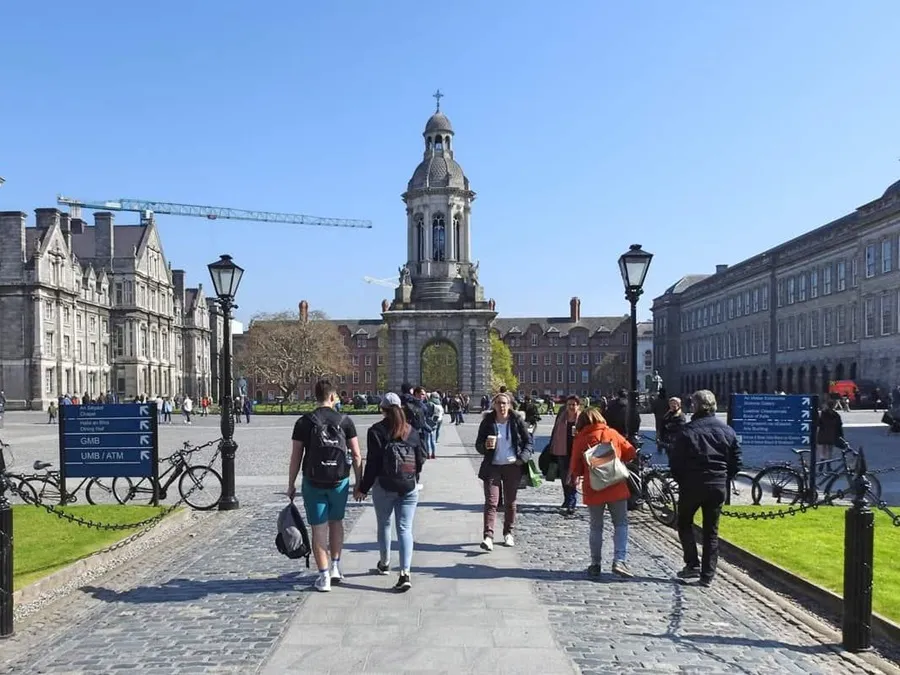
Ireland has emerged as an increasingly popular European destination for international students seeking high-quality, English-medium higher education. Home to global technology and pharmaceutical headquarters, top-ranked universities, and post-study work opportunities, Ireland offers a strong return on investment.
Non-EU/EEA students must navigate full international tuition fees, strict visa proof-of-funds rules set by the Immigration Service Delivery (ISD), and a competitive accommodation market. This guide breaks down every core expense you will encounter when studying in Ireland in 2026.
1. Non-EU tuition fees by degree level and subject
Higher education institutions in Ireland operate on a two-tier fee structure. While EU passport holders may qualify for free fees or reduced rates, non-EU international students pay full institutional tuition.
| Qualification level | Average annual tuition (EUR) | Key characteristics |
|---|---|---|
| Private college degrees (e.g. NCI, Griffith) | €10,000 – €18,000 | Most affordable options for business and computing degrees. |
| Public undergraduate — Arts & Humanities | €16,900 – €22,500 | 3- to 4-year degree programmes. |
| Public undergraduate — STEM & Business | €21,700 – €29,500 | Engineering, Computer Science, Finance, and Biotechnology. |
| Postgraduate Master's (taught) | €15,000 – €32,000 | Intensive 1-year degrees providing fast career entry. |
| Medicine & Dentistry | €52,000 – €60,000+ | Highest tuition tier across top medical faculties. |
2. Irish Student Visa proof of funds requirement (2026)
To secure a Stamp 2 Student Visa for Ireland, non-EU applicants must prove financial readiness through verifiable bank statements, sponsorship documentation, or education loans.
Mandatory visa financial benchmarks
Living expense baseline (year 1)
€10,000
For courses exceeding 8 months.
Upfront tuition prepayment
Min. €6,000
Paid receipt required before visa submission.
Subsequent years
€10,000 / year
Same living baseline required per additional year.
Total visa proof of funds (first year)
€10,000 (living expenses) + first-year paid tuition receipt
Bank statement vetting
ISD visa officers require 6 months of continuous bank statements showing clear, unencumbered liquid funds. Large, sudden deposits made immediately before submission must be supported by official source documentation — such as property sale deeds, land transfer receipts, or audited business income.
3. Upfront visa & on-arrival administrative costs
In addition to tuition and living funds, budget for these mandatory administrative fees:
| Fee | Cost | Details |
|---|---|---|
| Single-entry Student Visa | €60 | €100 for multi-entry visa. |
| Irish Residence Permit (IRP) registration | €300 | Paid on arrival when registering at Dublin immigration or a local Garda station to secure your Stamp 2 permission. |
| Mandatory private health insurance | €150 – €500 / year | Non-EU students must carry medical coverage for their entire stay. |
4. Monthly living expenses: Dublin vs. regional cities
Accommodation is the primary variable driving student monthly outlays. Dublin commands significantly higher rental rates than regional university centres like Cork, Galway, Limerick, or Waterford.
| Expense category | Dublin metropolitan area | Regional cities Cork, Galway, Limerick |
|---|---|---|
| Rent (shared flat / student room) | €900 – €1,500 | €350 – €750 |
| Groceries & food | €280 – €400 | €220 – €320 |
| Public transit (student Leap Card) | €50 – €100 | €40 – €80 |
| Utilities, mobile & internet | €80 – €140 | €70 – €120 |
| Personal & books | €120 – €220 | €100 – €180 |
| Estimated monthly total | €1,430 – €2,360 | €780 – €1,450 |
5. Working rights & post-study work routes (Stamp 1G)
Ireland provides structured employment permissions to help international students offset day-to-day maintenance costs and build workplace experience:
- Stamp 2 work hour limits: up to 20 hours per week during active academic terms, and up to 40 hours per week during official scheduled breaks (June–September and 15 December–15 January).
- National minimum wage: all student employees are covered by Irish minimum wage legislation, supporting predictable part-time hourly earnings.
Third Level Graduate Scheme (Stamp 1G)
Bachelor's graduates (NFQ Level 8)
12 months
Full-time post-study work rights in Ireland.
Master's & PhD graduates (NFQ Level 9+)
Up to 24 months
12 months initial + 12 months extension — full unrestricted employment access.
Key takeaway
Planning for higher education in Ireland requires balancing institutional tuition with realistic accommodation options — particularly the stark Dublin vs. regional cost gap. For a non-EU student, total annual expenses range from €22,000 to €45,000+ per year depending on course level, university choice, and city location.